
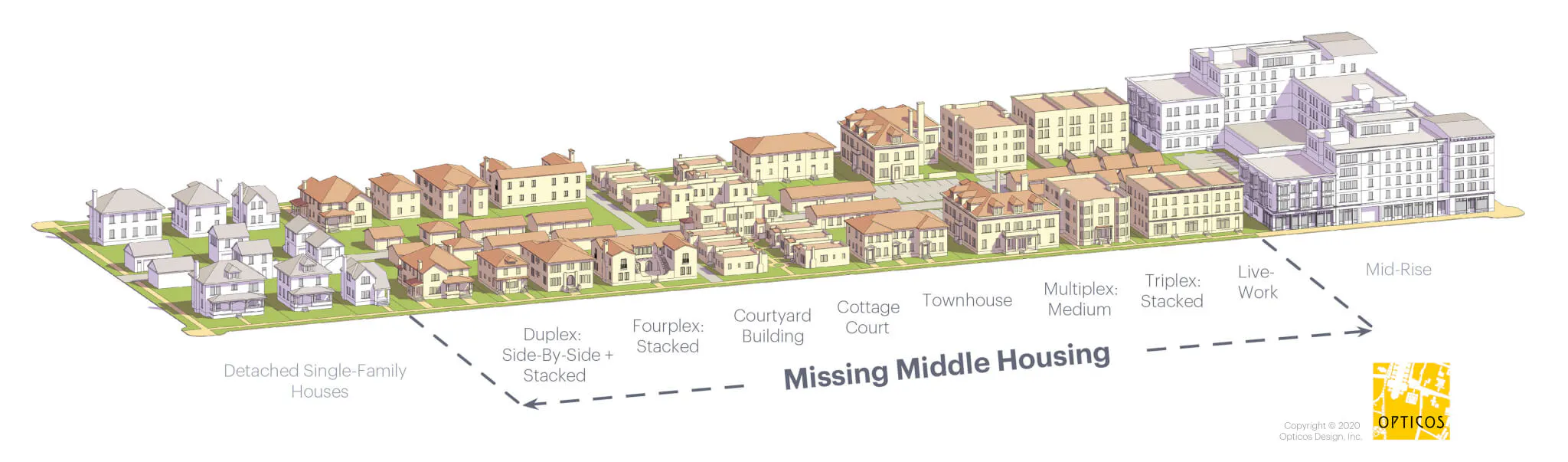
Incremental Development + Missing Middle Housing
WHAT IS THE INCREMENTAL DEVELOPMENT COUNCIL GOAL?
"Invest In Economic Opportunity. Implement policy recommendations regarding incremental development to encourage affordable, sustainable, and neighborhood-scale reinvestment."
Incremental development is a nationally recognized concept referring to small-scale, locally driven real estate development. Its focus is promoting development within existing neighborhoods that uses existing infrastructure and that is consistent with the existing fabric of a neighborhood. Through several City Council Study Sessions, City Council has provided direction, input and prioritization of Planning and Development Department activities to advance this Council Goal. City Council accepted three over-arching principles for implementing incremental development strategies in Champaign:
- Expand opportunities for housing choice and affordability within neighborhoods;
- Expand opportunities for small scale commercial development; and
- Ensure the changes to a neighborhood's building environment are gradual and compatible with existing neighborhood design.
IMPLEMENTING THE INCREMENTAL DEVELOPMENT COUNCIL GOAL
The Champaign City Council has directed staff to prioritize the following strategies to implement the Incremental Development Council Goal. These changes include:
- Phase 1 - Eliminate Minimum Off-Street Parking Requirements.
- Phase 2 - Allow Missing Middle Housing in All Zoning Districts.
- Phase 3 - Explore Building Code Amendments to Promote Additional Housing Types.
The Planning and Development Department is currently working on Phase 1 Amendments. These amendments will:
- Zoning Ordinance Refresh. These amendments will make our regulations clear and easy to navigate for staff, architects, developers and residents. These changes will reorganize the entire ordinance, simplify code language, and help facilitate more by-right and administratively approved development.
- Eliminate Minimum Parking Requirements. These amendments implement a key component of the incremental development Council Goal.
- Set the stage for future Missing Middle Housing Amendments. These amendments will allow for future text amendments to allow Missing Middle Housing to be easily incorporated into our new revised code. Additional community engagement is necessary prior to adopting any new regulations for Missing Middle Housing.
- Regular Zoning Ordinance Omnibus. These changes include non-controversial substantive changes as well as minor updates and corrections to the current code that would be adopted as part of our annual Zoning Ordinance Omnibus process. These amendments include the creation of a new Research Park Zoning District, amending ground floor commercial standards, aligning maximum building heights with building code requirements, and updating the lighting, landscaping ordinance, and historic preservation articles of the Zoning Ordinance.

Who's Listening
-

Phone 217-403-8800 Email bruce.knight@champaignil.gov -

Phone 217-403-8800 Email katherine.trotter@champaignil.gov -

Phone 217-403-8800 Email eric.vanbuskirk@champaignil.gov